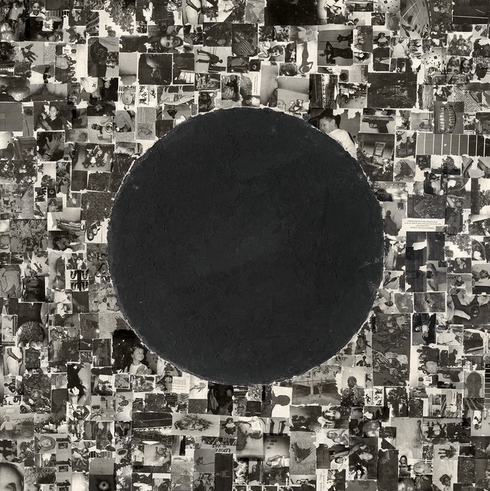
(An)Other: As If I Don’t Know My Name is a new body of work by Louie Perea, a New Mexico-based visual artist. Continuing their exploration of otherness and representation, Perea challenges the camera’s history of reinforcing colonial and White gazes by centering Black and Queer bodies, drawing on their experience navigating both Afro-Latinx and nonbinary identities. The work presents reconfigured images from Perea’s family photo archive alongside those from broader Black cultural and visual histories.
Perea shows us how Black identities, realities, histories, and memories are recorded, constructed, disrupted, fractured, reclaimed, and honored through family photographs, racialized imagery, images of violence, joy, and intimacy. Perea’s masterful implementation of the racialized imagery throughout (An)Other: As If I Don’t Know My Name, sets the stage and reminds audiences of how it has and continues to impact us on a personal, cultural, and societal scale. With intention and care, Perea put these colonial and White imagery in direct conversation with their family and Black cultural and visual histories through the use of overlays. Creating a ripple effect of accountability and honesty throughout the individual works and the exhibition as a whole.
Solvent Transfer
11 x 14”
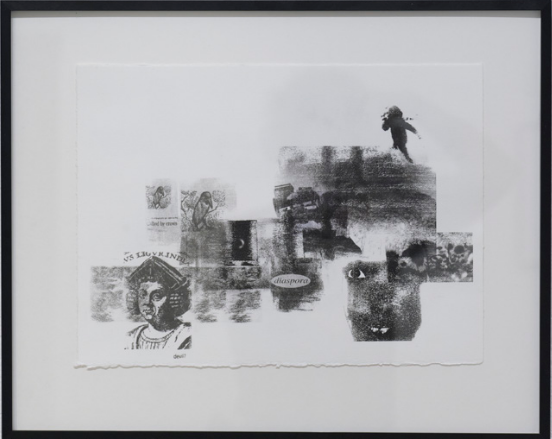
For example, in the piece, 1491, with respect to its namesake, the year 1491 was the year before Columbus allegedly discovered America. Perea shows us life experiences before the fateful year of 1492, where various forms of life, animal, botanical, and human, all had existed, had a reason and purpose for living that was outside of the interest of the White gaze. This is one of the first pieces that audiences experience, setting the tone that life, that Black life, existed before Columbus, while foreshadowing that it will continue to exist within and outside of the white gaze.
Throughout the exhibition, Perea implements techniques such as rubbing, applying pressure, lifting, and erosion, which can be seen as a literal and metaphorical representation of what has and continues to occur when it comes to Black narratives, histories, contributions, etc. There is an intentional and careful attention to detail effort of erasure, loss of records, the tearing apart of families and cultural heritage. This method reflects and brings to light how, in spite of the intentional wear and tear on the Black community, we rise, persevere, and continue to move forward while centering and honoring ourselves and one another.
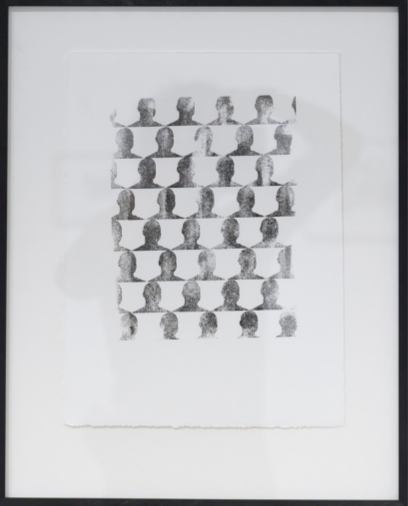
The silhouette of an unidentifiable Black man is present throughout select works, such as Untitled (Grid). As the title suggests, the motif of the Black man silhouette is presented in a grid formation, but with the mentioned techniques applied. These reworked and unrecognizable figures are in conversation with the noticeable and recognizable figures, which can speak to a number of things. Such as how society as a whole is unable to see us as individuals, unique and with humanity, but sees us as the same and something less than. Or that it’s just another Black person in the lineup. Perea’s selection of imagery allows for broadness and specificity depending on one’s personal experience and background in relation to the work.
In White Violence, Perea continues to show us that no matter how joyous the White imagery tries to appear, it doesn’t negate or erase the harm and violence that is taking place. We’re reminded how historically and even now, when White people have fun, it is at the expense of someone. Examples of this include, but are not limited to, lynching picnics, where White families would come to see violence and death inflicted upon Black men, and use it as a bonding moment and entertainment where they can eat, take in the “scenery”, and enjoy being in space with their “community”. There is imagery of guns throughout the piece, with White individuals, young and old, with smiles and bright eyes. This can speak to the constructed narrative about patriotism and how one, specifically White individuals, are able to protect and take what they believe is theirs.
(An)Other: As If I Don’t Know My Name, Perea creates a thoughtful space where audiences have no choice but to face the music, especially now more than ever in these times. To be honest, vulnerable and truly go there into the deep annals of our individual and collective histories, and how they are and have impacted our narratives. Perea does this by first leading by example and starting with themselves.
(An)Other: As If I Don’t Know My Name, is currently on view at CCA Santa Fe.
 Jarifuller
Leave a comment